Teamwork Makes the Dream Work: Collaboration and Communication in Ecommerce
Introduction
Welcome to the world of customer satisfaction and product delight! In the realm of product management, the Kano Framework emerges as a guiding light, illuminating the path to understanding and exceeding customer expectations. As we embark on this journey, let’s unravel the magic of the Kano Model — a tool that not only decodes what makes customers happy but also empowers product managers to create experiences that truly resonate. Get ready to explore the nuances of delight and discover how the Kano Framework can elevate your product management prowess.
The origins of Kano analysis: Dr. Noriaki Kano
In the 1980s, a clever product development expert named Dr. Noriaki Kano noticed something interesting. He saw that simply adding features to a product didn’t always guarantee happy customers.
So, Dr. Kano created a special framework, called the Kano Model, to help understand what features truly matter to users. This way, developers could focus on creating products that people actually wanted and needed, instead of just adding bells and whistles that nobody cared about.
What is Kano Model?
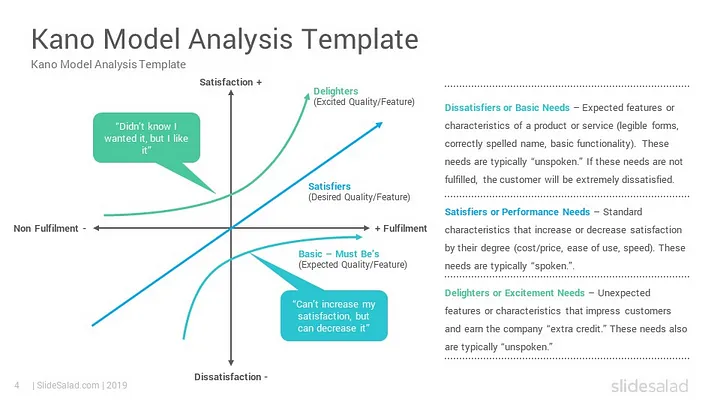
The Kano Model is a product development and customer satisfaction theory introduced by Professor Noriaki Kano in the 1980s. It categorizes customer preferences into five distinct categories, helping businesses understand and prioritize features based on their impact on customer satisfaction.
Why would you use kano analysis?
You would use Kano Analysis to understand exactly what your customers want and how different features impact their satisfaction. It helps you prioritize features based on customer preferences, distinguishing between must-haves, nice-to-haves, and delightful surprises. By using Kano Analysis, you can tailor your product development to meet customer expectations and even exceed them, ensuring a more satisfying and delightful user experience. It’s like having a roadmap that leads to not just meeting but surpassing customer needs.
Five categories of Kano model
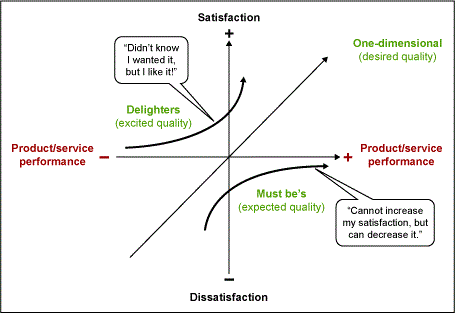
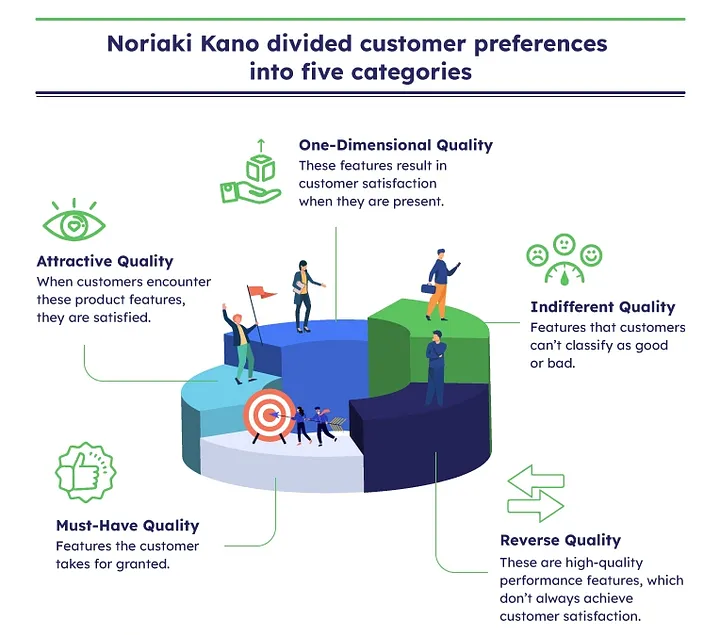
- Basic Needs (Must-haves): These are features users consider essential for a product to even be considered functional. Their absence would lead to extreme dissatisfaction. (Think: power button on a phone)
- Performance Needs (Nice-to-haves): These features directly increase customer satisfaction when present, but their absence doesn’t cause significant dissatisfaction. (Think: a camera on a phone)
- Excitement Needs (Delighters): These features are unexpected surprises that delight users and significantly increase satisfaction. They can be powerful differentiators from competitors. (Think: facial recognition unlock on a phone)
- Indifferent Needs: These features have little to no impact on user satisfaction, whether present or absent. (Think: pre-installed games on a phone)
- Reverse Needs (Dislikes): These features actually decrease user satisfaction when present. They might be perceived as unnecessary or cumbersome. (Think: excessive pop-up ads on a website)
2. Partnering with Engineers: Building the Example: Upgrading a Shopping App
- Fast Decisions Needed: — Situation: The shopping app faces increasing competition, requiring quick updates. — Kano’s Help: Kano analysis helps identify must-haves for immediate attention, ensuring the app stays relevant within tight deadlines.
- Limited Team Resources: — Scenario: The app team is small and lacks extensive research capabilities. — Kano’s Help: With a straightforward Kano questionnaire, the team efficiently gathers user opinions without straining limited resources.
- Wow Factor Exploration: — Scenario: The app aims to surprise users with innovative features. — Kano’s Help: Using Kano analysis, the team discovers potential delighters that could impress users, offering a unique and memorable shopping experience.
- Product Refresh Planning: — Scenario: The app needs a strategic overhaul for sustained competitiveness. — Kano’s Help: Kano analysis guides feature prioritization, ensuring a balanced focus on essential improvements and delightful surprises, contributing to the app’s overall enhancement.
Advantage and Disadvantage of Kano Model
Advantages of Kano Analysis:
- Customer-Centric Decision-Making: — Kano analysis ensures that product decisions prioritize customer needs and expectations, enhancing overall satisfaction.
- Efficient Resource Allocation: — It helps allocate resources effectively by focusing on must-haves and performance features that significantly impact satisfaction.
- Identification of Delighters: — The framework highlights potential delighter features that can exceed customer expectations, contributing to a positive user experience.
- Quick Decision-Making: — Kano analysis provides a relatively quick and straightforward method for analyzing customer preferences, aiding timely decision-making.
- Enhanced Communication: — It categorizes features into understandable groups, facilitating clear communication and fostering shared understanding among stakeholders.
Disadvantages of Kano Analysis:
- Subjectivity in Responses: — Responses to surveys may be subjective, introducing potential biases into the analysis.
- Limited Prediction of Market Trends: — While effective for understanding customer preferences, Kano analysis may have limitations in predicting broader market trends.
- Dependency on Customer Feedback: — It relies heavily on accurate and representative customer feedback, which may not always be readily available or comprehensive.
- Sensitivity to Survey Design: — The effectiveness of Kano analysis is sensitive to survey design, requiring careful consideration of wording and format.
- Static Nature of Results: — Results may reflect a snapshot in time and may not capture evolving customer preferences or market dynamics.
How to use Kano analysis?
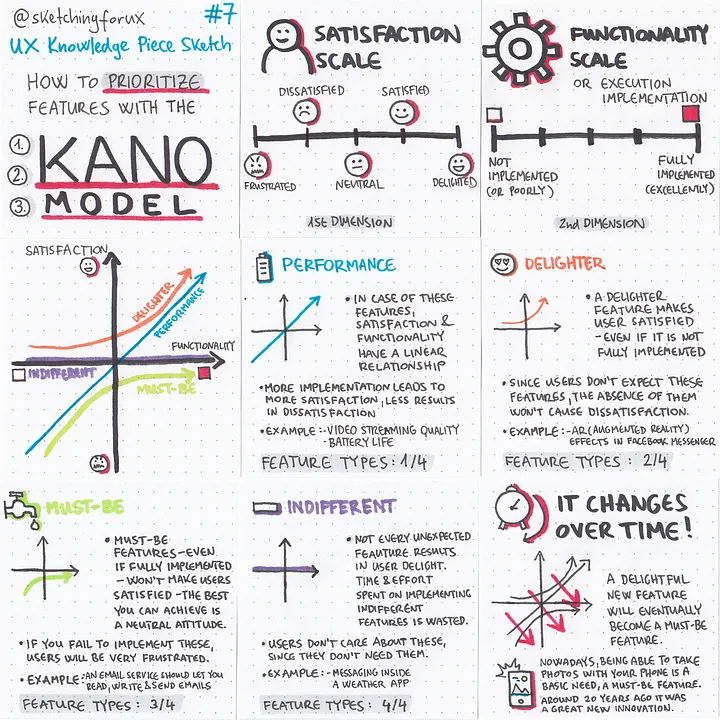
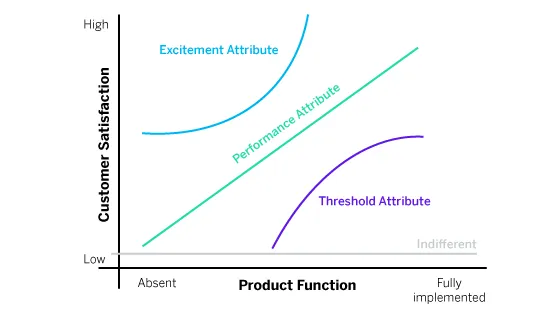
To understand how the kano reaction graph works, it’s important to understand satisfaction and functionality. The two below appear within the model as measurement scales to understand the customer’s response to a feature.
Kano created a satisfaction scale to run from ‘Delighted’ (indicating high satisfaction or excitement) to ‘Frustrated’ (indicating low or no satisfaction).

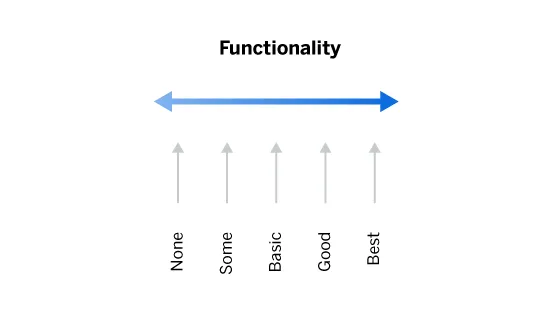
In addition, Kano created a functionality scale (also known as the Investment, Sophistication, or Implementation scale) that runs from ‘None’ to ‘Best’. This represents what level of function the customer thinks a feature provides. Has the feature been implemented to the highest level? Is this feature emotionally well-received by the customer?
Based on responses from the kano questionnaire, features can be plotted on the kano reaction graph based on its satisfaction and function level:
Best practice advice and tips for Kano analysis
Choosing the right features: Imagine showing your friends 20 different frosting flavors for your cake — any more and it might overwhelm them! Similarly, testing up to 20 features with Kano analysis is ideal to keep the process manageable.
Choosing the right people: Just like you wouldn’t invite only chocolate lovers to choose cake frosting, choose a diverse group of people for your Kano analysis who represent your target audience. Aim for a sample size of 15–20 people to gather enough data.
Getting the best answers: Clear communication is key! Make sure your questions about the features are easy to understand for everyone involved. Ask a teammate to review your questionnaire for clarity, just like asking a friend if your cake tastes good before serving it!
Understanding the “why”: While Kano helps categorize preferences, it’s also helpful to understand “why” people feel the way they do. Consider conducting short interviews to get deeper insights and context behind their responses. This is like asking your friends why they prefer a specific frosting flavor — maybe it reminds them of something special!
How could you use a Kano model to influence future strategy?
Imagine running a business is like predicting the future, and the Kano Model is your crystal ball. With technology changing fast and customers having different needs, businesses need to guess what’s coming. The Kano Model helps with this by predicting what features customers will want. It knows that what’s important now might not be later. For instance, a cool feature today might become something people don’t care about in the future. Think about CD/DVD drives in laptops — once a cool thing, now not many laptops have them. So, the Kano Model is like a superhero tool, helping businesses see into the future. It shows that what customers find exciting today might become just a basic thing they expect tomorrow. With the Kano Model, businesses can stay ahead, knowing what customers will want and staying sharp in the ever-changing business world. It’s like having a magic wand to understand and meet future customer needs.
Edit kano model template : https://app.creately.com/d/MQFTB8Hmkgk/editConclusion:
The Kano Model categorizes customer preferences into five groups: must-haves, nice-to-haves, delighters, indifferents, and dislikes. It helps businesses understand what features truly matter to users and prioritize accordingly. While limitations exist, Kano analysis offers advantages such as customer-centric decision making and efficient resource allocation. By following best practices, businesses can leverage the Kano Model to create products and services that meet evolving customer needs and stay ahead of the curve.